Insights
Deep Foundation
Our people are dedicated to finding solutions to every challenge. That spirit makes for some great stories.
Deep Foundation
Deep foundation is a type of foundation that transforms building loads to the earth farther down from the surface than a shallow foundation does to a subsurface layer or a scale of depths. A pile or piling is a vertical structural component of a deep foundation, driven or drilled deep into the ground at the building site.
Piling Works
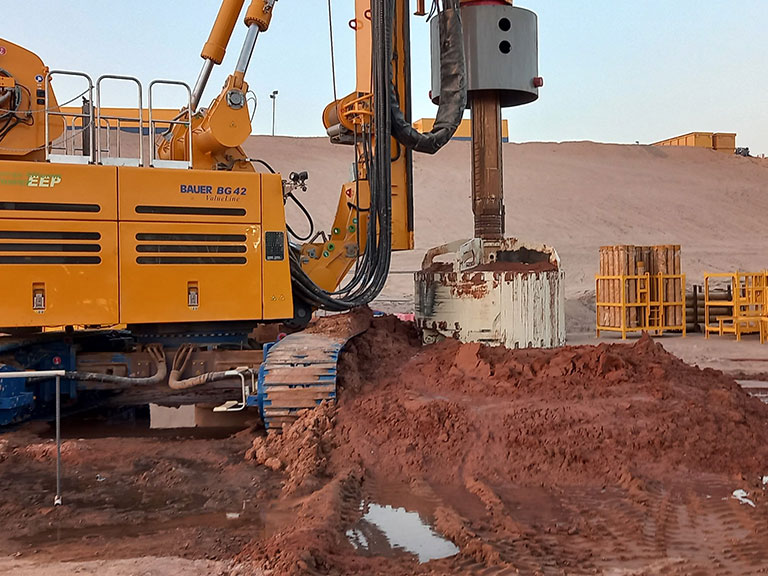
Piling works required to transfer the load to a deep level where vertical Columns of concrete and steel are driving deep into the ground to provide extra support to the building – towers – factories – skyscraper, that site on top. Piles are required where soil and earth are performing poorly and are used to spread the load of a building and firm the ground. They are cost-effective approaches to combating corrosion and are proven to significantly improve the life expectancy of a structure.
Drilling or pile foundation
It is a usually used foundation for supporting heavy vertical loads. It transfers the heavy loads to the soil below or rock strata with sufficient bearing capacity and minimizes the settlement of the structure.
Polymer slurry
Polymer slurry work is used in the deep foundation pilings of buildings and infrastructure like bridges, marine docks, roads, piers, flyovers, subways, railways, and stadiums
Polymer slurry work absorbs water and prevents it from getting concrete and steel used in the deep foundation pilings.
Steel Cage
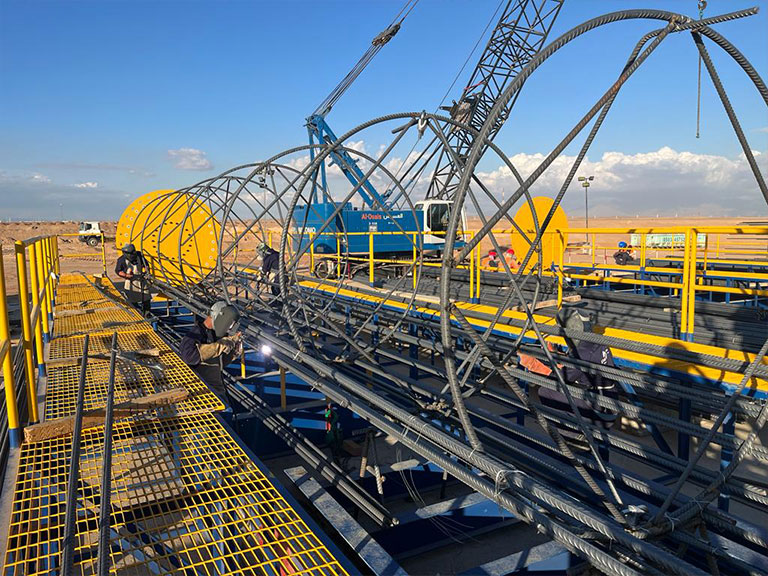
Steel Cage is a type of construction, commonly for high and heavy buildings, in which the loads and stresses are transmitted to the foundations by a steel framework of beams and columns; the walls are supported by the framework.
Piling Test
Piling Test (also known as low-strain dynamic test, sonic echo test, and low-strain integrity test) is one of the techniques for assessing the condition of piles or shafts. It is cost-effective and not very time-consuming.
Pile integrity testing using low-strain tests such as the TDR (Transient Dynamic Response) techniques, is a quick way of assessing the sustainability and integrity of concrete piled foundations.